
The Stories of Britain: Myths, Cultural Identity and World War One
How did our cultural identity come about? How were myths, legends and stories of British history used to form, impact, and, in many ways, control British cultural identity? By looking at the myths of King Arthur and St George, Zachary Peatling explores the construction of British Cultural Identity, and how it was weaponised during the First World War. Recorded live at Chalke History Festival 2024.
How do you build a culture?
One of the main ways humans have built cultures and civilisations throughout history is through the stories we tell. It makes sense - humans are enstoried beings. Our lives are our own stories, our world is a cosmos of narrative. What is history if not the gathering, penning and retelling of all the stories of past civilisations, heroes and villains, empires and conquests, beasts and angels, life and death.
Humans have always told stories. Not only to entertain, but to also form and mould behaviour, morality and even identity. Children are raised on stories, and whether conscious or not, they inevitably mould themselves on the heroes or villains of these stories. Stories have an almost unrivalled way in which they can capture, grow and set alight the imagination of individuals and nations. Great kings and warriors have gone to war to emulate the epics of their gods and heroes. Governments and nations have united around stories, religions have started because of stories, people have changed the entire trajectory of their lives, because of the stories they hear, and the stories they tell. So often, the process of inculturation is done through the stories we tell.
And what stories do, is they enable grand themes, moral codes, virtues, goals, ambitions, desires, to be so imaginatively illustrated and embodied, that they are easy to remember, and exciting to emulate. How much easier is it to say to someone, be like Aragorn from Lord of the Rings, rather than, be courageous, strong yet gentle, a leader and a friend, wise yet active. Or, King Alfred the Great epitomises all that it is to be English, follow after him; rather than saying, stand for your nation, protect it from invaders, establish education and social structure. Stories are ambitions made manifest; morality embodied; values and virtues illustrated.
There is also something innate within us that resonates with stories. As the American author, ND Wilson once wrote: ‘stories are soul food’. Stories have a way of resonating with a deep-set part of our identity. This translates nationally too. Every nation, especially distinctive in the ancient to early modern eras, has their foundation myth, their story of how they came to be. In it, you’ll usually find elements of what they would recognise as their cultural identity. What it means to be English, American, Indian, Greek, can be uncovered layered deep within their origin stories. And, this continues in the stories we continue to tell ourselves today. Every nation has their national heroes. George Washington, Robert the Bruce, King David, Mahatma Gandhi, the Red Baron, and the like. These heroes become icons and examples for a nation of people to try to emulate, and for a nation’s leaders to encourage their people and country to follow after.
We can see this blatantly clearly in the history of Medieval Britain. Geoffrey of Monmouth, writing in 1136, created a History of Britain that could be used to trace the lineage of his King, Stephen, all the way back to Brutus, the heir of the Trojans. This story was used to present the King as intimately connected to the heirs of the heroes of antiquity, drawing a straight line from the present King to the myths and legends of the highly respected, highly educated, sophisticated and beloved Ancient Greek world. It was also used to present Britain as, not only a nation worthy of recognition alongside Greece and Rome, but also as the best nation of all. I mean, this is how Geoffrey starts his very first chapter: ‘Britain, the best of islands, is situated in the Western Ocean’. This was not uncommon in the medieval period, with stories, histories and myths being written to connect their present with a past they wanted, to present themselves as the true heirs of this lineage, and as a nation worthy of this heritage.
Geoffrey also included, and brought to life, as history, the story of King Arthur. Now, whatever you believe about King Arthur, whether he was real or not, whether he is purely a myth or not, that didn’t matter to Geoffrey. He included Arthur as history. And he had it all, he was the heir of the Romans, the great protector of the British Isles from the oncoming Saxon invaders, the last vestige of all the civilisation, glory and power of the Romano-British identity.
Geoffrey wrote this of Arthur: ‘ Arthur was a youth of such unparalleled courage and generosity, joined with that sweetness of temper and innate goodness, as gained him universal love. Arthur resolved to make use of his courage, and to fall upon the Saxons. To this he was also moved by the justice of his cause, since the entire monarchy of Britain belonged to him by hereditary right.’
What are we seeing here? The archetype of courage, kindness, generosity, goodness, justice, power, respect, duty. I mean, Geoffrey isn’t very subtle about it, but see how much admirable virtue is communicated in such a small paragraph. This is the power of story.
This was to continue throughout the medieval and early modern periods, with King Arthur gaining a distinct place in the identity and national folklore of Britain. One example of this I personally love, is the Round Table in Winchester Great Hall. Supposedly, it is the round table of King Arthur, but if you look closely at the king figure in the centre, you might recognise him: not as King Arthur, but as King Henry VIII. He had it specially painted to look like him so he could claim direct heritage from the Arthur of legend. This shows how deeply ingrained King Arthur had become in Britain’s cultural myth and identity. Everything Arthur represented was what Henry wanted to be recognised for, and Britain thought themselves to be. Our cultural identity was built on the figure of Arthur, in all his courage, kindness, generosity, goodness, justice, power, respect and duty.
Alongside the legend of Arthur also rose the story of St George and the Dragon. As most of you will know, the story goes that a town was being harassed by a dragon, and to appease him, they would feed him their sheep. But soon enough, they ran out of sheep and began to sacrifice their children to him. A lottery system was set up to decide which child was going to be sacrificed that year. Eventually, the lottery called the name of the King’s daughter. It just so happened that George, a legendary soldier from the Roman legions, potentially a member of Roman aristocracy, sources differ, was passing by. He saw the plight of the town, and of the King, and decided to put an end to this foul beast. Now here is where the early stories diverge. Some say that St George fought the dragon and slew him in combat. Others say that he defeated the dragon, tied a rope around its neck and took it before the king as a prize. Once recognised by the King, he slew the dragon with his sword. Either way, George would go down as the great British hero that saved the princess from the dragon, and the town from its oppressor. Again, we see a similar thing: virtue embodied in a legendary hero. Courage, honour, chivalry, justice, power and strength. Throw in some distinctly Christian homages to the fight against child sacrifice by the people of God in the wilderness of Exodus, and to the image of a Christian warrior hero putting faith into action, and you have a story that will resonate with a nation, and form a significant part of its national identity. We still celebrate St George’s Day today, and our flag is the St George’s Cross. Our cultural identity was forged in the stories of George, in all his courage, honour, Christian virtue, goodness, justice, power, chivalry and duty.
And from the Medieval period to the modern, this only increased. These cultural symbols and heroes became more entrenched. They came to symbolise a bygone Britain that was not only in our heritage, but also in our aspirations. We yearned for a world that existed in our myths - there was a kind of mythologised nostalgia. We longed for heroes that may not have actually truly existed - in the same way we today might long for that time where England were a formidable, world beating football team. It was nostalgic and aspirational - they represented everything we believed ourselves to be, and everything we wanted to be. We were the nation of St George and King Arthur, and we could still be the nation of St Georges and King Arthurs. As Haley Claxton, a historian, wrote in her piece, The Knights of the Front: ’In the centuries between the Middle Ages and the start of the First World War in 1914, stories of knights, chivalric codes, and other forms of “medieval history” were well recognised and formed “a prism through which the contemporaries viewed the present.”’
And then, in 1914, the world began to change. A war began that would shift how culture, society, war and politics was done. This was the first, real, total war in history. Every facet of society was mobilised. The factories, the music, the cinemas, the politics, the churches, everything became captured and geared towards the war effort. It was unprecedented and changed the face of Britain forever.
Before the war broke out, it is important to remember, Britain was in turmoil. If anything, rather ironically, the announcement of the war was a chance for Britain to steady itself, as the issues that had plagued them tempered. The workers were striking, and the government was being way too heavy handed sin their response, the women were getting increasingly violent in their fight for enfranchisement, and the Irish were on the verge of a civil war. All three, individually, played crucial roles in shaking the foundations of the British state, and, in tandem, were a difficult storm for Britain to weather.
Any beauty the old stories of Britain held, was overshadowed and silenced by the turmoil and upheaval of the early 20th Century. It took the war to reunify the nation and reestablish the cultural centrality of these myths and legends. There was a collective enemy that we could all fight, together, as one. That sounds familiar. King Arthur had his Saxon hordes. St George had his dragon. We now had our enemy: the Central Powers. We, as a nation, could now fight like the heroes of old, we could go to war as they did, exhibiting all the courage, honour, virtue, goodness, justice, power, chivalry and duty that they had.
And this started very early in the war effort. As soon as Belgium was invaded and destroyed, the medievalist rhetoric began. It was easy to translate the story of St George into the present situation: Belgium, the Princess, being threatened and potentially devoured by the German dragon, Britain, able to swoop in as the great chivalric knight to slay the dragon and save the princess. Finally, the modern British man had the opportunity to fight as the mythological heroes. He could stand alongside George and Arthur, he could be quintessentially, mythologically British.
It also allowed for a renewed synthesis in being chivalric and gentlemanly, and being a warrior hero. As Allen Frantzen wrote in his book: ‘Bloody Good: Chivalry, Sacrifice, and the Great War’ : ‘“It was the work of medieval chivalry to turn the warrior into a gentleman. It was the work of World War I to turn the gentlemen of the nineteenth century into warriors. Chivalry worked as well for the second purpose as for the first”’ Expanding on this, here’s Haley Claxton again: ‘Visual representations of “the armoured knight... setting off to defend the weak, uphold the king’s honour, and find glory in combat... supplied a vigorous model for the modern soldier,” and encouraged men to see these ambitions as reasons to sign up to join the war effort. These three goals (to defend defenceless women and children at home, to maintain national pride, and to gain personal prestige) were the socially voiced war aims sought by most of the individuals who voluntarily joined the military during the Great War.’
This opportunity for some really effective propaganda and recruitment material was not missed by the government. And, they found themselves in a unique position among the warring powers. Neither invaded nor possessing a system of conscription until 1916, the British public had to be persuaded to participate in the tectonic move to a total war footing. They knew they had to mobilise culture. The great myths and stories of old had to be marched out to the field.
Herbert Asquith, a month into the war, gave a great speech about the plight of Belgium and the duty of Britain, saying: “We shall not sheathe the sword until Belgium recovers all, and more than all, she has sacrificed,”
This was also immediately reflected visually too. Take a look at this poster:
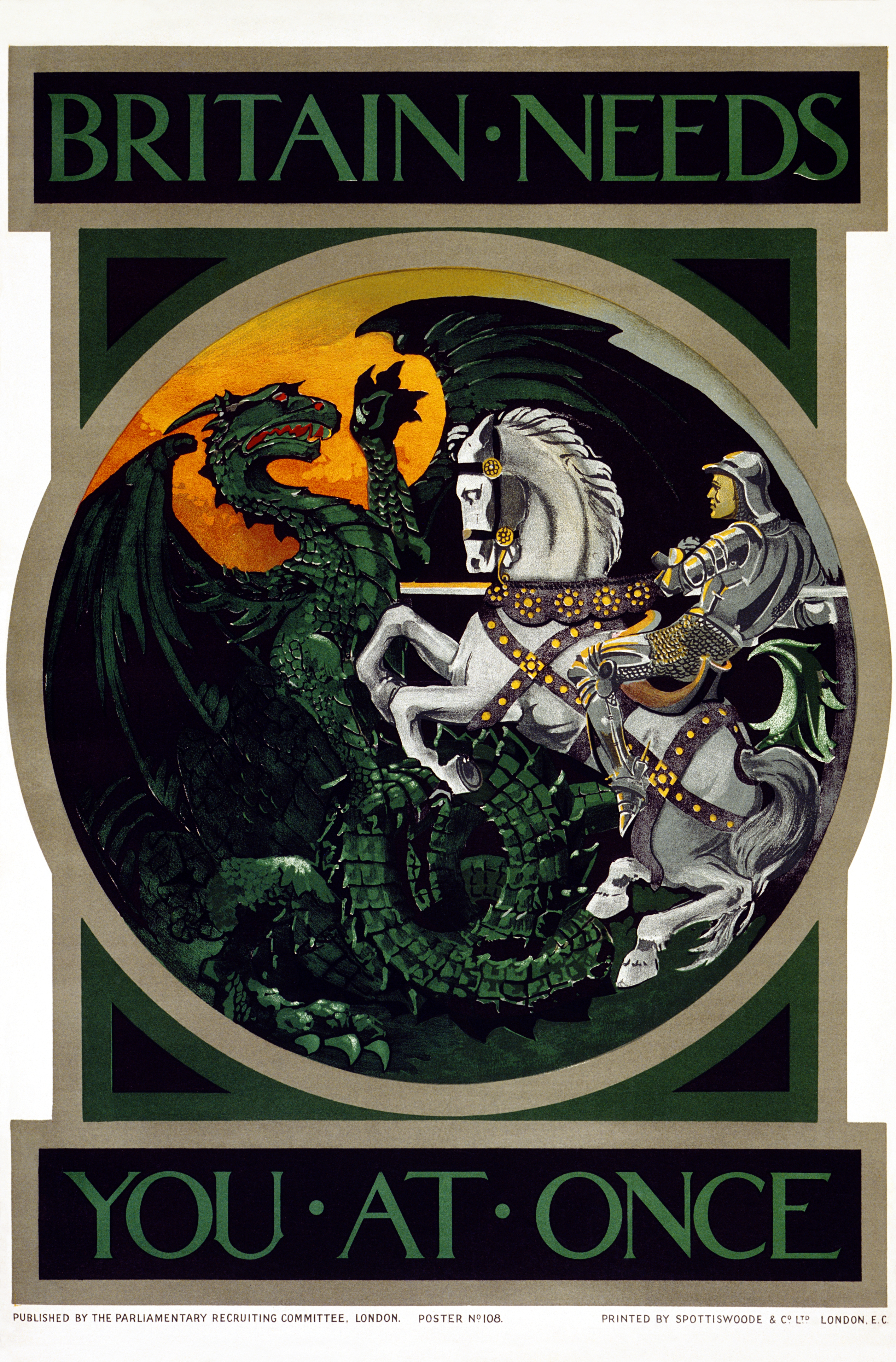
Again, it is explicit and visceral: Britain needs you at once, to stand in the place of St George, fight the dragon and deliver victory, not only for yourself, or even just for the victim, but also for your country. Patriotic pride was indelibly inked on the medieval propaganda of the time. Not only were the individual soldiers and recruits St Georges, but the nation itself was a collective St George.
We could go to war to emulate everything we believed ourselves to be innately, and everything we wished ourselves to be presently. Indeed, Reverend G.D. Rosenthal writing in The Church Times, on 21 December 1917, put it so clearly: ‘St. George is once more struggling in Syria with the Dragon, glutted with the blood of his Armenian victims. Our armies in France, as in Palestine, are on pilgrimage: they are fighting for the Cross; they are engaged in the same Holy War in which Richard Coeur de Lion and his crusaders pitted themselves against the Saracens in days of yore. For all of which Jerusalem is the symbol, for truth, for honour, for justice, for righteousness, for freedom - these are the things for which England is giving her all to-day.’
This framed the war as another incident of classic British heroes doing as they always have: fighting with Christian virtue, courage, honour, goodness, justice, power, chivalry and duty. It was instep with the cultural image we had of ourselves. It placed us alongside our heroes as their heirs and equals.
This weaponisation of medieval myth and legend worked obscenely well. Chris Baker, in his book The Long, Long Trail: The British Army in the Great War says: ‘The use of propaganda in World War One had a profound impact on the conflict. This was one of the forces that encouraged the rapid growth of the British army, which recruited a total of 4,006,158 men from England alone, not including English colonies, between 1914 and 1918.’
Looking back at the war on St George’s Day, 1918, a correspondent in The Times wrote about the ‘strain’ of St George on British history and identity, saying: ‘Nor did the strain fail, when the war broke upon the world. The youth of this land would never have taken the sword as they did if it had not been for them a crusade. They saw a dragon across the path, and they had to go. [...] They in the memory of the world will be held with the hosts of Christian chivalry’. This shows just how deep the story, myths and legends were embedded in British cultural identity, and our perception of the war at the time.
So, if all this was so naturally and deeply embedded in our cultural identity, so much so that it would be mobilised, weaponised and perpetuated, the question naturally arises: where has it gone? Why do we not have the same sense of connectedness with the medieval Britain as the First World War Britons had?
Well, there are many answers to this, and maybe a few of them can be drawn out in the question time after this, but one of the main reasons was, that as the war ended, and the true extent, destruction and catastrophe was seen, the human toll was experienced and the national effects felt, disillusionment began to set in. I don’t know whether I could put it better than Claxton, as she writes: ‘by the end of the war, these ideals had been shattered. War was not a glorious spectacle with glittering swords and shining armour in which dragons were slain and damsels in distress were saved. Instead, it was hell on Earth. This realisation would forever leave an impact on those who had lived through the Great War. In their retelling of war, battle would no longer be an epic folk history of chivalry. Instead, many survivors told the opposite story.’
This is the other side of the cultural identity coin. However high you build up your cultural identity on stories, myths, legends, heroes and chivalry, will be how far they fall when they are revealed to be empty, false or unattainable. As soon as a promise of glory fails, as soon as a hero is revealed to be less than perfect, as soon as the promises of mythology start to break down, cracks can start to emerge in the collective identity. The First World War was revealed to be a hellish horror show of death, destruction and loss. All the medieval propaganda was forced to yield to this reality.
That’s why our perception of the First World War is what it is today: futile, pointless and unnecessary. Partly because of the true human cost and political impact, but also because it didn’t match up to the mythic rhetoric it had been shrouded in.
And yet, our culture is still built on stories today. We still have our heroes, villains and legends. Some may hold George and Arthur closer than others might. But we all have our myths and tales. So, let me finish with a question to you: what stories are you listening to, believing, and telling? Who are your heroes and villains? And to echo the question we started with: how do you build your culture?
Further Reading:
Stefan Goebel, The Great War and Medieval Memory: War, Remembrance and Medievalism in Britain and Germany, 1914-1940
Mike Horswell, The Rise and Fall of British Crusader Medievalism, 1825 – 1945
Haley Claxton, The Knights of the Front: Medieval History’s Influence on Great War Propaganda
Allen J. Frantzen, Bloody Good: Chivalry, Sacrifice, and the Great War
James Lewis Henderson, A Bridge Across Time: The Role of Myths in History


