
St George and the Soul of England
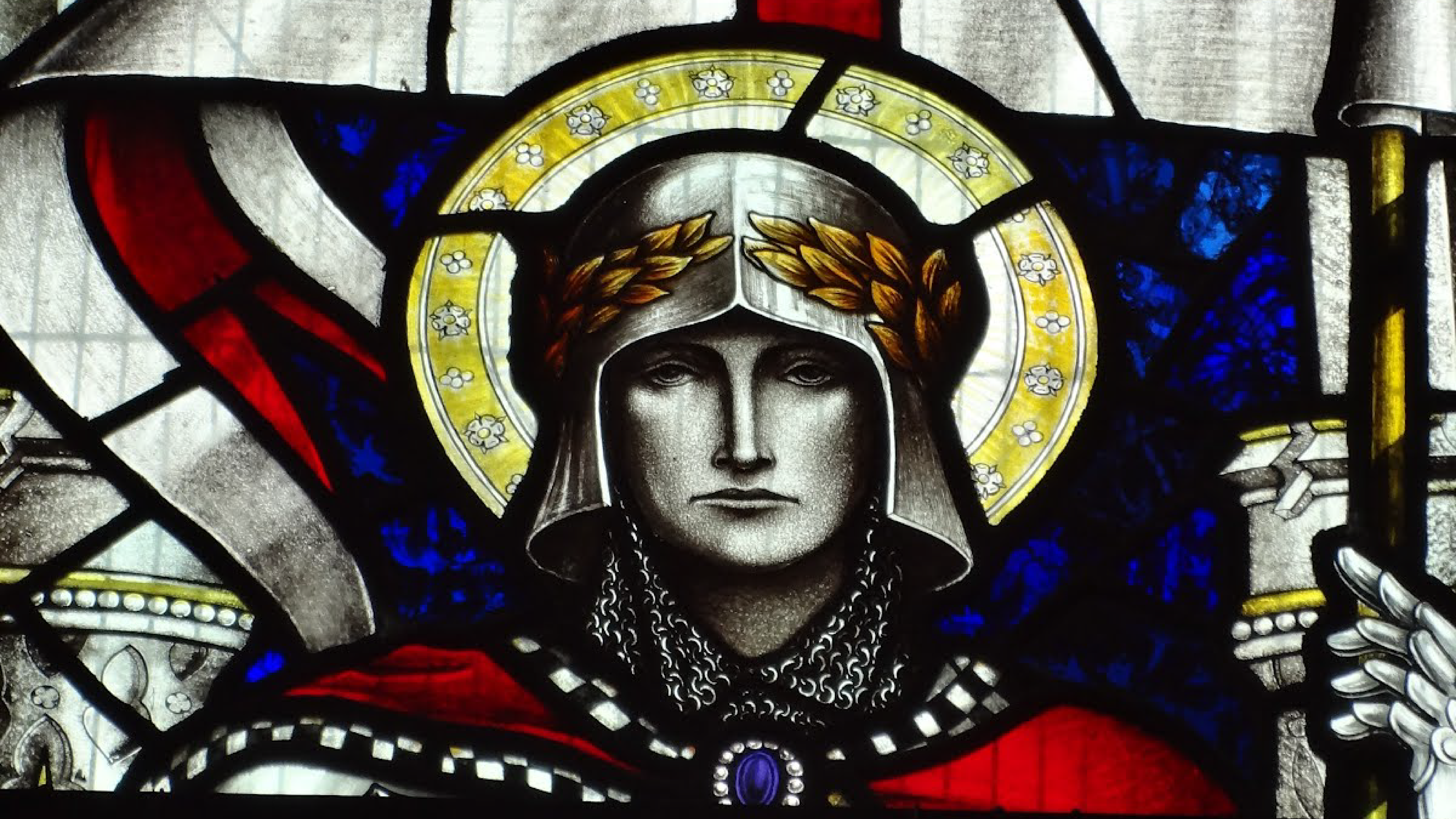
There is something magnificently English about the patron saint of England being a man who was almost certainly Cappadocian Greek, who never visited England (although it is within the realms of historical possibility), who may or may not have existed in the form his legends describe, and who is shared as a patron saint with Georgia, Ethiopia, Portugal, Catalonia, and the city of Moscow. The English have always had a talent for adopting foreign things and making them irreducibly their own (their language being the most obvious example, a magnificent mongrel tongue built from Norse and Norman French and Latin and Anglo-Saxon) and St George is perhaps the most spectacular instance of this cultural alchemy.
Yet to say that George is merely a borrowed symbol is to misunderstand how symbols work. A nation does not choose its patron saint the way one chooses a logo; the choice accumulates over centuries, through war and prayer, through plague and parliament, through the instincts of soldiers in the dark before battle and kings reaching for a rallying cry. That England reached, again and again across a thousand years, for this particular figure, this soldier-martyr who refused to recant, who faced imperial power with nothing but faith and defiance, tells us something deep and true about what England has, at its best moments, wished to be.
The Man Behind the Dragon: Martyr Before Myth
The historical George, insofar as we can reconstruct him, was a Roman soldier of Cappadocian origin who was executed at Lydda (modern-day Lod in Israel) around 303 AD during the Great Persecution of Diocletian.¹ The emperor Diocletian had launched the most systematic and brutal suppression of Christianity the Roman world had yet seen, ordering churches destroyed, scriptures burned, and Christians who held imperial office stripped of their positions and rank. George, who appears to have been a tribune or officer of some standing, refused to comply. He tore down the imperial edict against Christians, declared his faith publicly, and was consequently tortured and beheaded.
That much, or something like it, appears to be historical bedrock. The Bollandists, those meticulous Jesuit scholars who have spent four centuries sifting the hagiographical wheat from the chaff, concluded that while the legendary accretions around George are spectacular and largely fictional, the core of a Christian soldier-martyr at Lydda under Diocletian is credible.² Eusebius of Caesarea, writing in his Ecclesiastical History around 313 AD, mentions without giving a name ‘a man of the highest distinction’ who tore down the imperial edict at Nicomedia at the very start of the persecution, a detail that has led some scholars to identify this unnamed hero with George.³ The church at Lydda was certainly ancient and the veneration real; by the late fourth century, George's cult was sufficiently established that the Council of Nicaea in 325 AD had recognised his feast day.
The dragon, it should be said plainly, came considerably later. The fire-breathing serpent of the famous legend, the princess, the helpless town, the knight who arrives at the last moment to slay the beast, appears in literary form first in the Golden Legend (Legenda Aurea) of Jacobus de Voragine, compiled around 1260.⁴ It is a wonderful story. It is also almost certainly an allegory rather than biography, the dragon standing variously for Satan, for paganism, for the persecuting Roman empire, and for all the monsters that a Christian soldier is called to face. Medieval people understood their allegories perfectly well; they did not need scholars to explain that the dragon was metaphorical. What the story gave them was a shape, a visual grammar for an idea; that faith, armed with righteousness, could overcome the seemingly invincible, which is a rather more portable and powerful idea than any strictly factual biography could convey.
The Crusades: When England Found Its Saint
George's adoption as England's patron is inseparable from the Crusades, and specifically from the remarkable vision reported at the Siege of Antioch in 1098. The First Crusade was, by any rational military assessment, on the verge of collapse. The crusader army, having taken Antioch after a gruelling siege, now found itself besieged in turn by a vast Turkish force under Kerbogha of Mosul. Food had run out. Horses were dying. Deserters were slipping away in the night. Then, according to multiple chronicle accounts, including those of Raymond of Aguilers, Fulcher of Chartres, and the anonymous Gesta Francorum, a peasant named Peter Bartholomew claimed to have been visited by visions directing him to a buried lance beneath the floor of the cathedral of St Peter. The discovery of this relic (almost certainly genuine in its spiritual effects if not its physical provenance), combined with visions reported by others of heavenly armies led by St George, St Demetrius, and St Mercury riding down from the hills to fight alongside the crusaders, galvanised the starving army.⁵ They marched out on June 28, 1098, against overwhelming odds, and routed Kerbogha's forces in what contemporaries and the men themselves could only understand as a miracle.
Richard I, Coeur de Lion, the lion-hearted king whose heart was perhaps the only part of him consistently pointed at England, placed his army under George's protection during the Third Crusade. He reportedly saw a vision of George before the Battle of Jaffa in 1192.⁶ Whether Richard was a deeply sincere devotee or a shrewd military psychologist who understood that men fight harder under a celestial commander is, perhaps, a distinction without a difference. The effect was the same: George became associated with the English martial enterprise in a way that proved extraordinarily durable.
Edward III's formal adoption of George as England's patron saint, replacing the earlier patron Edmund the Martyr, and the foundation of the Order of the Garter in 1348 under George's banner consolidated this identity at the highest institutional level.⁷ The Garter, the most prestigious chivalric order in Christendom, took as its motto Honi soit qui mal y pense (Shame on him who thinks ill of it) and as its spiritual patron the soldier-saint of Cappadocia. The chapel at Windsor, consecrated to St George, became and remains one of the great sacred spaces of English royal and national life, the burial place of ten monarchs and the spiritual home of the order. Edward's choice was not accidental: he was prosecuting what would become the Hundred Years' War against France, and a martial saint of unimpeachable Christian credentials served his purposes admirably.
The Red Cross: A Symbol That Outlived Its Kingdom
The cross of St George, a red cross on a white field, is both older and stranger than it looks. Its precise origins are disputed, but it appears in English military contexts from at least the thirteenth century, and by the time of Edward I it was becoming recognisable as the English military standard. What is remarkable is how the symbol stabilised and persisted when so much else changed around it. The Reformation abolished monasteries, stripped churches, and overthrew the entire theological apparatus within which medieval saint-veneration had operated; and yet the cross of St George survived. The now Protestant nation kept the popish saint's emblem, flying it from cathedrals it had stripped and ships it was using to build an empire the medieval crusaders could not have imagined.
The flag's incorporation into the Union Jack in 1606, when James VI of Scotland became James I of England and the crosses of George and Andrew were superimposed, gives it a further layer of historical density. The resulting flag, later completed with the cross of St Patrick in 1801, is itself a kind of theological argument rendered in heraldry: three saints, three nations, one crown.⁸ That the George cross sits at the heart of this composite, literally and symbolically, is fitting for a saint whose meaning had always been composite: eastern in origin, western in adoption, Roman in context, Christian in essence.
Agincourt and Shakespeare: The Saint Goes to the Theatre
No account of St George's cultural significance can pass over Henry V at Agincourt, and no account of that can ignore Shakespeare, who is himself a kind of second patron saint of England. On October 25, 1415, Henry V's exhausted, dysentery-ridden army of perhaps 6,000 men faced a French force estimated at between 12,000 and 36,000. The victory, when it came, was so complete and so improbable that contemporaries and the men themselves reached immediately for the supernatural. The chronicler Thomas Walsingham, writing at St Albans, recorded that the English cried ‘St George!’ as they advanced and attributed the victory to divine intervention.⁹
Shakespeare's version, written roughly two centuries later for a London audience that had never stopped needing heroes, gives us the cry in its most memorable form: ‘God for Harry, England, and Saint George!’ ¹⁰ The line is splendid theatre, but it is also documentary evidence of a kind, evidence that by 1599, the association of George with English martial identity was so well-established that Shakespeare could use it as emotional shorthand, confident that any groundling in the pit would feel its pull. What is fascinating is what Shakespeare does with George in that play: he is invoked but never appears, a presence felt rather than dramatised. George is, in Henry V, what he has always been in English life: not a person who acts within the story, but the spirit that animates the people who do.
The play's famous St Crispin's Day speech, which precedes the battle, does not mention George at all, and yet it breathes his air. It is a speech about a band of brothers, about shared suffering becoming shared glory, about the willingness to die for something larger than oneself. These are, precisely, the values that the George legend had been transmitting for six centuries: the soldier who refuses to betray his faith when enemy powers demand it, who faces death with courage, who leaves behind not an empire but a story.
The Saint Goes to War (Again): 1914–1918
The Great War produced, in its extremity, a remarkable revival of the Georgeian legend. Arthur Machen's famous short story ‘The Bowmen’, published in the Evening News on September 29, 1914, described phantom archers from Agincourt appearing to aid the retreating British forces at Mons.¹¹ Machen always maintained that it was pure fiction. It did not matter. The story was absorbed into popular consciousness with remarkable speed, and by 1915 a substantial portion of the British public believed that actual supernatural assistance had been rendered at Mons, that the Angel of Mons (sometimes specified as St George himself) had appeared on the battlefield. The ecclesiastical establishment was largely sceptical; the soldiers and their families were not, or at least they wished not to be. There is something very human, and very English, in that distinction.
The official military uses of George were more measured but no less significant. The battle cry ‘St George for England’ was still current in the British army in 1914, carried into a mechanised, industrialised war that George's medieval inventors could not have conceived. The Gallipoli campaign was launched on April 23, 1915, St George's Day, a coincidence that was certainly noted and possibly not entirely coincidental.¹² Field Marshal Haig, whatever his tactical limitations, understood the power of tradition, and the regimental systems of the British army were saturated with historical and religious symbolism in which George played an integral part. Dozens of English regiments carried George's cross on their colours, their cap badges, their regimental silver.
Rupert Brooke, that golden Edwardian whose death in the Aegean in April 1915 became its own kind of martyr-myth, had written in ‘The Soldier’ of an English corner of a foreign field, of ‘a pulse in the eternal mind, no less / Gives somewhere back the thoughts by England given.’¹³ It is thoroughly Georgeian in spirit: the sacrifice of the individual that becomes something permanent and transcendent, the soldier's death transformed into something that speaks beyond itself. Brooke was not consciously invoking George, but he was drawing from the same deep well of English martyr-consciousness that George had filled.
The Second War: George's Cross Goes to Malta
The Second World War produced the most direct and literal use of George's name in British military history. On April 15, 1942, again, note the proximity to St George's Day on the 23rd, King George VI awarded the George Cross collectively to the island of Malta, the only time in history that a collective body rather than an individual has received the award.¹⁴ His citation reads: ‘To honour her brave people I award the George Cross to the Island Fortress of Malta to bear witness to a heroism and devotion that will long be famous in history.’ Malta had endured more than two years of sustained aerial bombardment, suffering more bomb tonnage in a single month in April 1942 than Britain had suffered throughout the entire Blitz of 1940–41. The choice of the George Cross, rather than any purely military medal, was deliberate: it was a civilian population being honoured, for precisely the kind of steadfast, refusing-to-yield courage that the George legend had always celebrated. The saint who would not recant, who stood firm against imperial power and died rather than surrender, had found his contemporary embodiment in a population that would not surrender the Mediterranean.
A Protestant Saint, a Secular Nation, and the Awkward Business of April 23rd
There is a final paradox to be addressed. England is today becoming one of the most secular nations in the world, and April 23rd, St George's Day, is celebrated with nothing like the national fervour of St Patrick's Day in Ireland or St Andrew's Day in Scotland. The English flag, absent for much of the twentieth century except on church towers and football terraces, has enjoyed something of a rehabilitation in recent decades, though it has also attracted some political controversy.¹⁵
C.S. Lewis, writing in a different context, observed that 'the past is not dead; it is not even past.’ George's past is very much present, even when unacknowledged. Every time an English cricketer walks out at Lord's under overcast skies, every time a red-and-white scarf appears in a crowd, every time a church tower flies its simple red cross against a grey English sky, the long argument that George represents, about faith, about courage, about the individual who stands firm against power, is quietly being continued. You do not have to believe in dragons to believe in dragon-slaying. You do not have to be a medieval Catholic to understand that a man who dies rather than betray what he believes is worth remembering. You do not, in the end, have to be sure that George ever lived to be sure that what he represents is real.
To celebrate St George's Day at all, even perfunctorily, is to be confronted with an inescapable fact: that England was, for the better part of a thousand years, a comprehensively Christian civilisation, and that this Christianity was not a decorative addition to its national life but its very architecture. The parish churches that punctuate every English village, the cathedrals that still organise the geography of English cities, the common law with its roots in canon law, the universities founded to train clergy, the literature from Bede to Milton saturated in Scripture; none of this is incidental. It is the substance. To ask who St George is, then, is to ask a question that modern England finds genuinely uncomfortable, because a fully honest answer requires acknowledging that England was not simply a nation that happened to have a Christian patron saint, but a nation whose entire moral and cultural vocabulary was Christian in origin, and which has never quite found an adequate replacement for what it has so actively and so thoroughly set aside. George, standing there on his feast day in his red and white, is less a relic of medieval superstition than an ambassador from a version of England that modern England simultaneously inherits, inhabits, and refuses to acknowledge; a civilisational creditor whose debts are still being paid, whether or not the debtor knows to whom the payments are owed.
The English, characteristically, have never quite resolved their feelings about their patron saint. They celebrate him inadequately, argue about his flag intermittently, and largely ignore his feast day. But he persists. He has persisted through Reformation and Revolution, through Empire and its end, through two world wars and the long complicated peace that followed. There is something almost Georgeian about that persistence itself; the refusal to be abolished, the continuing presence despite all the forces arrayed against it. The dragon, in this reading, is history itself, with all its power to erase and forget. And the saint, as always, is still there.
Footnotes
¹ For the historical foundations of the George tradition, see S. Baring-Gould, The Lives of the Saints, Vol. IV (Edinburgh: John Grant, 1914), pp. 254–268.
² The Bollandist analysis is summarised in Acta Sanctorum, April Vol. III (Antwerp, 1675), under April 23, with extensive critical apparatus by the seventeenth-century Bollandists questioning the legendary material while affirming the martyr tradition.
³ Eusebius of Caesarea, Historia Ecclesiastica, Book VIII, Chapter 5, trans. G.A. Williamson (London: Penguin, 1965), p. 258.
⁴ Jacobus de Voragine, Legenda Aurea, trans. William Granger Ryan (Princeton University Press, 1993), pp. 238–242.
⁵ Raymond of Aguilers, Historia Francorum qui ceperunt Iherusalem, trans. John Hugh Hill and Laurita L. Hill (Philadelphia: American Philosophical Society, 1968), pp. 63–68. See also Gesta Francorum et aliorum Hierosolimitanorum, ed. Rosalind Hill (London: Nelson, 1962), pp. 69–74.
⁶ Roger of Hoveden, Chronica, ed. William Stubbs, Rolls Series 51, Vol. III (London: HMSO, 1870), p. 180.
⁷ The foundation of the Order of the Garter is documented in Elias Ashmole, The Institution, Laws and Ceremonies of the Most Noble Order of the Garter (London, 1672), Book I, Chapters 1–4.
⁸ For the heraldic history of the Union Flag, see William Perrin, British Flags (Cambridge University Press, 1922), pp. 44–62.
⁹ Thomas Walsingham, Gesta Abbatum Monasterii Sancti Albani, ed. Henry T. Riley, Rolls Series 28, Vol. III (London: HMSO, 1869), p. 395.
¹⁰ William Shakespeare, Henry V, Act III, Scene I, line 34, in The Complete Works, ed. Stanley Wells and Gary Taylor (Oxford: Clarendon Press, 1986), p. 598.
¹¹ Arthur Machen, "The Bowmen", Evening News, September 29, 1914; reprinted in The Bowmen and Other Legends of the War (London: Simpkin, Marshall, Hamilton, Kent & Co., 1915).
¹² Michael Hickey, Gallipoli (London: John Murray, 1995), p. 78.
¹³ Rupert Brooke, "The Soldier", in 1914 and Other Poems (London: Sidgwick & Jackson, 1915), p. 15.
¹⁴ The original letter from King George VI awarding the George Cross to Malta, dated April 15, 1942, is held in the National War Museum of Malta, Valletta. The text is reproduced in Joseph Attard, The Battle of Malta (London: Kimber, 1980), p. 183.
¹⁵ For a thoughtful academic account of the flag's modern reception, see Peter Gill, The St George's Cross: Flag, Nation and Identity in England (Sheffield: Sheffield University Press, 2019), pp. 112–145.


